
The basement is where Toledo mold lives
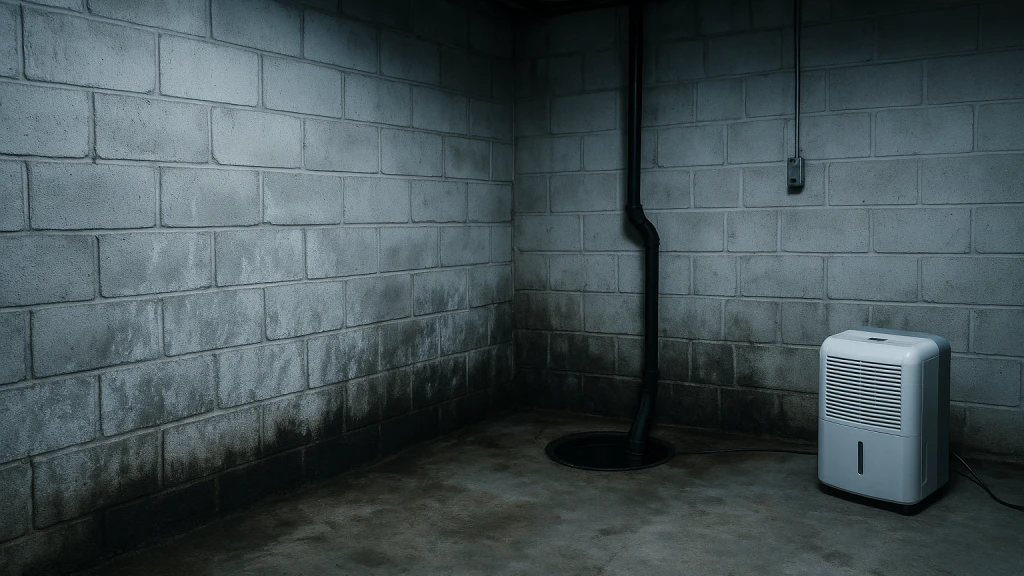
If there's one room that defines mold in this city, it's the basement. Toledo sits on heavy lake-plain clay that holds water like a bowl, the water table runs high near the Maumee and the bay, and the housing stock skews old, with block and stone foundations that were never truly waterproofed. Add a humid summer, a forced-air furnace pulling air through the lowest level of the house, and a sump pump that's one power outage away from quitting, and you have the perfect machine for growing mold below grade. The musty smell you notice at the top of the basement stairs is usually the first sign.
Basement mold rarely comes from a single dramatic leak. More often it's the slow accumulation of moisture from several directions at once: water seeping through the cove joint where the wall meets the floor, vapor wicking up through an uncovered slab, humid summer air condensing on cool concrete, and the occasional sump overflow or backup. Each one alone might be tolerable; together they keep the lower level damp enough for mold to colonize drywall, paneling, carpet, stored cardboard, and the wood framing of a finished basement.
Why finished basements are the bigger problem
An unfinished basement with a little surface mold on the block is a manageable cleanup. A finished basement is where the real money and the real hazard hide. When studs, drywall, carpet pad, and paneling are installed tight against a foundation that still weeps, moisture gets trapped in the cavity with no way to dry. Mold grows on the back of the drywall and the bottom plates where you can't see it, sometimes for years, until a smell or a health complaint finally forces the wall open. By then the affected materials almost always have to come out.
The remediation process for a Toledo basement
A licensed crew approaches a basement methodically, because the goal isn't just to remove what you can see — it's to remove the hidden growth and stop the cavity from getting wet again.
- Find and stop the water. Moisture meters and a look at grading, downspouts, the sump, and the cove joint identify how water is getting in. Nothing else matters until this is understood.
- Contain the work area. Poly sheeting and a negative-air HEPA scrubber keep spores from riding the furnace ducts up into the living space during demolition.
- Remove affected materials. Wet drywall, paneling, carpet, pad, insulation, and contaminated baseboard are cut out and bagged. Block, concrete, and sound framing are HEPA-vacuumed and wiped rather than thrown away.
- Dry to a measured target. Dehumidifiers and air movers bring the slab, block, and framing down to a verified safe moisture content — not just "feels dry."
- Treat and rebuild smarter. Remaining surfaces get an antimicrobial, and any rebuild uses a wall gap, moisture-tolerant materials, and a sealed or dimpled-membrane approach so the next damp spring doesn't restart the cycle.
Fixing the water, not just the mold
This is the part DIY cleanups skip and live to regret. Removing basement mold without addressing the moisture is repainting a leaky boat. Depending on what the inspection finds, the durable fix might be exterior grading and downspout extensions to move roof water away from the foundation, a sump pump with a battery backup so a Toledo power outage doesn't flood the pit, interior drain tile and a vapor barrier, crack injection on a poured wall, or simply running a properly sized dehumidifier through the humid months. Often it's a combination. A good remediation pro will be candid about which fixes the job actually needs and which are upsells. Our guide on stopping basement mold walks through these in plain terms.
What basement mold removal costs in Toledo
Cost tracks how much finished material has to come out and how much drying the space needs. A small unfinished-basement cleanup might run a few hundred to a couple thousand dollars. Stripping and rebuilding the lower portion of a finished basement — with containment, material removal, drying, and reconstruction — commonly lands in the low-to-mid four figures, and a whole finished basement gutted after a chronic moisture problem can reach five figures, especially once you add waterproofing. If a sump failure or backup is involved, see flood and water-damage remediation; if growth has reached the rest of the house, whole-home remediation may be the right scope. The honest first step is almost always an inspection so you know how far it has actually spread.
What you can salvage and what has to go
One of the first questions homeowners ask is what they'll lose. The honest rule is that porous materials that have been wet and grown mold generally can't be reliably cleaned and come out, while non-porous materials usually can be cleaned and kept. That means wet drywall, paneling, carpet, carpet pad, and soaked fiberglass insulation are typically removed, while the concrete block, the slab, sound framing, metal, and finished hard surfaces are HEPA-vacuumed, treated, and saved. Stored belongings fall in between: sealed plastic bins and hard items can often be wiped down, but cardboard boxes, upholstered furniture, and papers that have grown mold are usually not worth saving and can keep re-seeding the space if kept.
Knowing this in advance helps you protect what matters. If your basement is prone to dampness, storing keepsakes and important documents in sealed bins up off the floor — never in cardboard directly on the slab — spares you the worst of these losses when a wet spring or a sump failure hits.
How long a basement remediation takes
Homeowners are often surprised that the drying, not the demolition, sets the timeline. Removing affected materials might take a day; drying the block, slab, and framing to a verified moisture target with dehumidifiers and air movers commonly takes several more, because rushing it just leaves moisture behind to regrow. A small contained basement cleanup might wrap in a couple of days, while a larger finished-basement project — demolition, drying, treatment, verification, and then reconstruction — can run one to two weeks before the space is back to normal. A good pro will give you a staged timeline up front and won't close the walls until the moisture readings say it's dry. That patience is precisely what keeps the mold from coming back.