
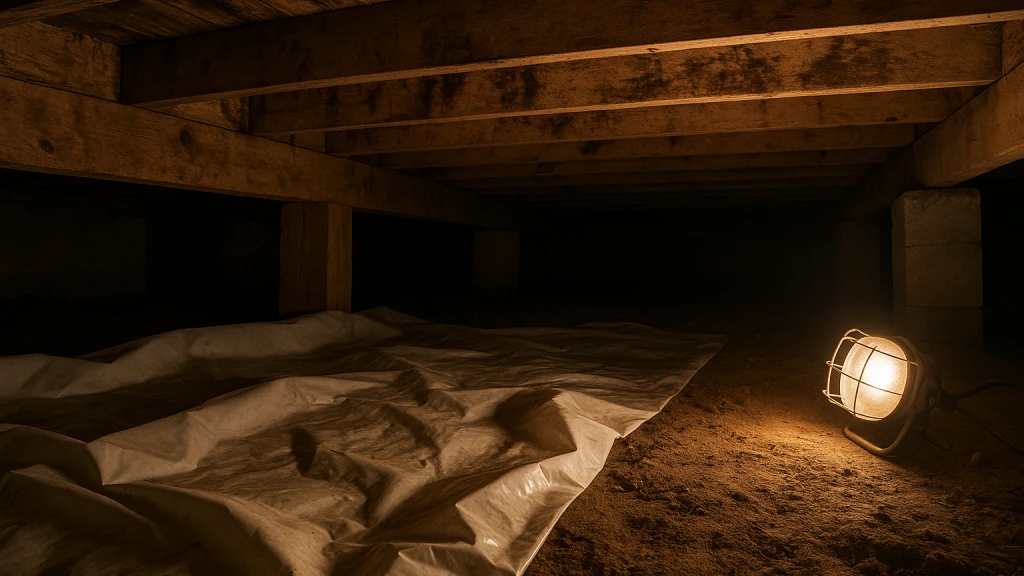
The crawl space problem under older Toledo homes
Plenty of homes around Toledo — older bungalows, additions, and houses in the river towns — sit over a crawl space instead of a full basement. Out of sight under the floor, these spaces are one of the most reliable mold factories in Northwest Ohio. The ground underneath is bare or barely covered, the foundation vents were designed to "let it breathe," and for decades that was considered good practice. We now know that in a humid lake climate, those vents often do the opposite of what they promise.
Here's the trap: in summer, warm, humid Toledo air flows in through the vents and hits the cool surfaces of the crawl space — the block walls, the ductwork, the underside of the subfloor. Just like a cold glass of water sweats on a humid day, those surfaces condense moisture out of the incoming air. Combine that with vapor rising from a dirt floor and the occasional plumbing drip, and the joists, subfloor, and insulation stay damp enough to grow mold for months at a time. Because almost no one goes down there, it's usually discovered only when a musty smell rises into the house or a home inspector crawls under during a sale.
Signs the crawl space is the source
- A musty or earthy smell on the first floor, strongest near floor vents or in rooms over the crawl space.
- Cupped, springy, or cold floors above the crawl space.
- Insulation that has fallen out of the joist bays or hangs dark and sagging.
- Visible white, green, or black growth on the underside of the subfloor and on floor joists.
- Higher allergy or asthma symptoms in the house even when the upstairs looks spotless.
How crawl space remediation is done
Crawl space work has its own rhythm, because the space is tight, the materials are structural, and the long-term fix is as much about moisture control as cleanup.
- Assess moisture and growth. A pro reads the joists, subfloor, and ground moisture, identifies the water sources — humid vent air, ground vapor, plumbing leaks, poor drainage — and scopes how far the mold has spread.
- Remove and clean. Contaminated, fallen insulation and any rotted material are removed and bagged. The joists and subfloor are HEPA-vacuumed and treated; structural wood is cleaned rather than replaced wherever it's still sound.
- Dry the space. Dehumidification brings the wood down to a safe, measured moisture content before anything is sealed up.
- Encapsulate and control moisture. The durable fix is usually a vapor barrier across the ground, often with the vents sealed and a dedicated dehumidifier or conditioned-air approach — turning a vented, humid crawl space into a dry, sealed one.
The structural stakes
Crawl space mold isn't only an air-quality issue — it's a building-health issue. The same chronic moisture that grows mold also rots subfloor and joists over time, which shows up as soft, bouncy floors and, eventually, expensive structural repair. Catching and correcting a crawl space moisture problem early is far cheaper than replacing framing later. It also protects the air in the rooms above, because the "stack effect" pulls crawl space air up into the living space, carrying spores and that musty smell with it.
What crawl space mold removal costs
Pricing depends on the size of the crawl space, how much insulation and material must be removed, how much structural wood needs cleaning, and whether you encapsulate. A straightforward clean-and-treat on a small crawl space may run a modest four figures; a full job with insulation removal, antimicrobial treatment, a vapor barrier, and a dehumidifier runs higher, with encapsulation adding to the total but delivering the lasting fix. Because the space is hard to assess from a doorway, an inspection is the right starting point. If the moisture has reached the floors and walls above, you may also be looking at broader remediation. Tell us what you're noticing upstairs and we'll connect you with a local pro who handles crawl spaces.
Vapor barrier vs. full encapsulation: what's the difference?
As you research crawl space fixes, you'll run into two terms that get used loosely. A vapor barrier is plastic sheeting laid over the dirt floor to block ground moisture from rising into the space — an important first step, but on its own it leaves the vents open and the air uncontrolled. Encapsulation goes further: a heavier liner sealed across the ground and up the walls, the foundation vents closed and sealed, and the air actively managed with a dehumidifier or by conditioning the space. In Toledo's humid, high-water-table climate, full encapsulation is usually what actually stops crawl space mold from returning, because it addresses both the ground moisture and the humid outdoor air that condenses on cool framing.
The right level for your home depends on how wet the space is, whether you're near the water, and your budget. A drier crawl space in a higher-and-dryer part of the metro may do well with a vapor barrier and a dehumidifier; a damp one near the river or bay typically needs the full sealed system. A pro who assesses the actual moisture down there can tell you which your home needs rather than selling you the most expensive option by default.
Catching it before it reaches the floor above
Because crawl spaces are out of sight, the cheapest time to deal with them is before the moisture works its way up into the living space. Watch for the early tells on the first floor: a musty smell near floor vents, floors that feel cool or springy over the crawl space, and allergy symptoms that don't match a clean-looking upstairs. A quick look under the house once a year — or having it checked during any home inspection — catches a developing problem while it's a cleanup rather than a structural repair. If your home sits over a crawl space and you've never looked, that first inspection is well worth it.