
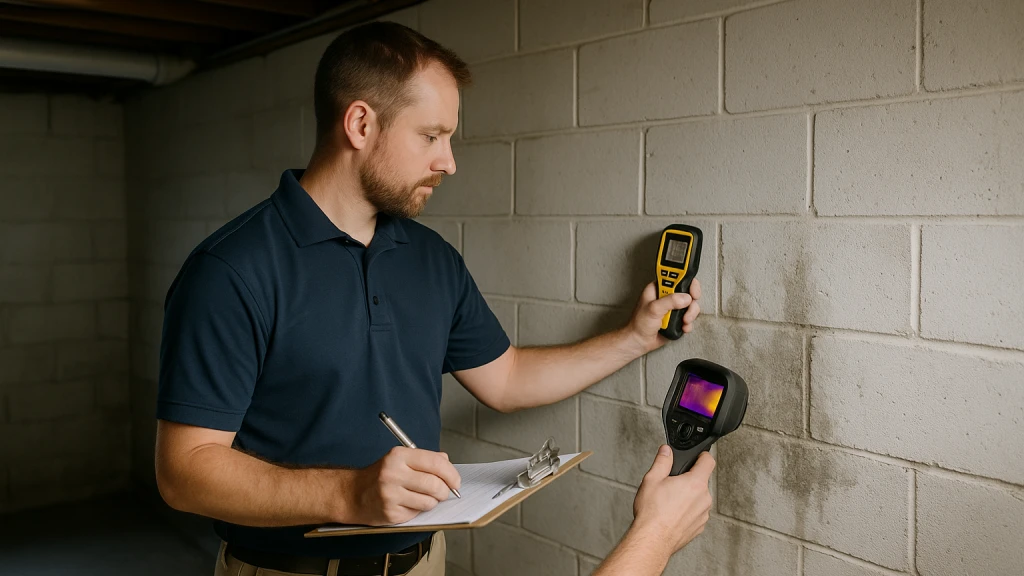
What a Toledo mold inspection actually involves
A real mold inspection is mostly a moisture investigation. Mold is the symptom; trapped water is the disease, and in Toledo the water has a lot of ways in — a block basement wall pulling moisture out of saturated clay, a sump pump that quit during the spring thaw, an ice dam that backed water under the shingles last February, or a slow supply-line drip behind a 1920s plaster wall in the Old West End. A competent inspector walks the house with that history in mind, not just a flashlight and a guess.
Expect a licensed, independent inspector to start with a conversation about what you've noticed: where the musty smell is strongest, when it started, any flooding or leak history, and which rooms feel damp. From there they move through the home with a moisture meter and usually a thermal camera, reading walls, floors, and ceilings for the cool, wet signatures that mark hidden water. They check the obvious Toledo trouble spots — the basement perimeter, the rim joist, around the water heater and furnace, under sinks, behind the washer, and the attic sheathing — and they look for the staining, efflorescence, and warped trim that tell a story about how long moisture has been present.
When testing is worth it — and when it isn't
Testing gets oversold. If you can see mold and smell it, a lab result rarely changes the plan: the affected material still has to come out and the water source still has to be fixed. Honest inspectors will tell you that. Where sampling earns its keep is when the problem is invisible — a persistent musty smell with no visible growth, a finished basement where you suspect mold behind the paneling, a real-estate deal where a buyer or seller wants documentation, or a household member with unexplained respiratory symptoms and no obvious source.
Two kinds of samples are common. Air samples capture airborne spores and compare an indoor count against an outdoor baseline taken the same day — the comparison matters far more than the raw number, especially in a humid lake climate where outdoor spore counts swing with the season. Surface samples (tape lifts or swabs) identify what a specific patch of growth actually is. Good practice is to sample with a question in mind: "Is this room elevated compared to outside?" or "Is that dark patch on the joist Stachybotrys or harmless Cladosporium?" Sampling without a question just generates a number you can't act on.
Why independence matters
The cleanest inspection is one where the person assessing the problem doesn't profit from the size of the cleanup. When a single company both tests and remediates, there's a built-in temptation to find a big problem. An independent inspection — or at minimum a clear separation between the inspection and the bid — gives you a scope you can trust and a second opinion you can take to any contractor. That's part of why we serve homeowners with independent local professionals rather than steering everyone to one crew.
What you get at the end
A thorough inspection should leave you with a written summary: where moisture was found, the likely source, the approximate extent of any growth, any lab results with the outdoor comparison, and a recommended scope of work. That document is what you hand to remediation contractors so they're all bidding the same job — which is how you get comparable quotes instead of wildly different numbers.
- Moisture mapping of basement walls, floors, rim joists, and any room with a complaint, using meters and thermal imaging.
- Source diagnosis — tying the moisture to seepage, a leak, condensation, or a past flood rather than just noting "it's wet."
- Targeted sampling only where it answers a real question, with same-day outdoor baselines for air tests.
- A written report and scope you can use to collect apples-to-apples remediation bids.
How inspection fits the bigger picture
For most Toledo homes, an inspection is the smart first move when you smell mold but can't find it, when a basement has flooded more than once, or when you're buying or selling and need to know what's behind the walls. If growth is already visible and the cause is obvious — say, a clearly wet basement corner after a sump failure — you may be better served by going straight to basement remediation and water-damage drying. Either way, understanding the moisture source is the part that keeps mold from coming back, which is why we treat inspection as the foundation of every other service we connect you with. If you're not sure which you need, describe the situation and we'll help you sort it out, or read our guide on the signs of mold in a Toledo home.
What to have ready before the inspector arrives
You'll get more out of an inspection if you can give the inspector the home's moisture history up front. A few minutes of preparation often shortens the visit and sharpens the findings. Before the appointment, jot down when you first noticed the smell or growth, which rooms feel damp, and any water events you remember — a basement that took on water during a storm, a roof leak that got patched, a sump that failed, an ice dam two winters ago, a slow drip under a sink. Note whether anyone in the home has had unexplained respiratory symptoms and whether they track with a season or a room.
Make the suspect areas accessible, too. Clear stored boxes away from basement walls, make sure the inspector can reach the sump, the water heater, the furnace, and any crawl-space or attic access, and unlock that back bedroom closet you've been avoiding. The more of the house the inspector can actually read with a meter and camera, the fewer blind spots in the report. If you're buying the home and won't be present, ask your agent to ensure access to the basement, attic, and any crawl space — those are exactly the spots a quick walkthrough skips and a real inspection won't.
Reading your report like a pro
When the written report comes back, focus on three things: where the moisture is, what's likely causing it, and what scope of work is recommended. A good report ties each finding to a cause — "elevated moisture at the north basement wall, consistent with exterior seepage" — rather than just listing readings. That cause-and-effect is what lets you fix the right thing. If lab results are included, look for the indoor-versus-outdoor comparison rather than the raw spore count, and don't be alarmed by the presence of common molds outdoors; that's normal. The report's value is the roadmap it gives you for getting comparable remediation bids and fixing the moisture for good.